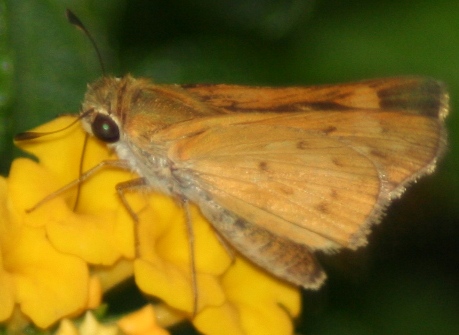
Fiery Skippers (Hylefila phyleus)
These skippers are very common in midsummer in North Carolina but are not resident here. This species is sexually dimorphous, meaning that the male and female are different in appearance. Wings markings become more complex in the fall. Worn skippers look different. Female Fiery Skippers show especially interesting variations from the norm.
We saw a lot of fiery skippers in 2003, especially in the North Carolina Botanical Garden, but few in 2004. However, 2005 numbers were up this August. These dramatic differences are probably typical of species that migrate through here but don't take up residence.
Females
There are some mysteries here that still need resolution. Immediately below are some ventral views of female Fiery Skippers, including the heavily spotted late year skippers:
 |
 |
 |
 |
| Durham, 8/1/05 | NC Botanical Garden, 11/01/03. Female Fiery Skippers do look different in the fall, as Jeff argues, but perhaps not quite the same as those on the left. So maybe the regional variation that Alex suggests explains the rest. | Dare County, NC, 10/6/05. Female. | Durham, 10/31/05. Almost sachemlike! |
Here are some other skippers that Jeff Pippen says are also Fiery Skippers, but anomalous because of their wing checkerboard pattern, apparently a function of the season. I have seen no photos of skippers like these from any other source and would welcome information about this. Alex Grkovich says that he has seen skippers like this in the Texas Hill Country just west of San Antonio, and has noted their similarity to female Sachems; he is not ready to jump to any conclusions.
 |
 |
 |
 |
 |
| Durham, 9/28/05. | Duke Forest, Gate 12, Durham, NC, 9/29/05 | Same skipper | Dare County, NC, 10/6/05. | Another view of skipper on left. |
 |
 |
 |
| Carolina Beach, NC, 10/19/05 | Same skipper. | Another skipper, same place and time |
 |
| Female Fiery Skipper, unusually dark, though more wing pattern variation occurs in the fall. Johnston Mill Nature Preserve, 9/27/07 |
The dorsal views of female Fiery Skippers show some of the most elaborate skipper wings patterns. There's some variation here: the dark areas predominate in the individuals appearing later in the year.
 |
 |
 |
 |
 |
| Duke Gardens, 7/24/05. | Durham, 9/1/03 | Durham, 9/12/05. | Durham, 9/19/05 | Durham, 9/22/05. Slightly anomalous wing pattern. |
 |
 |
| Lake Crabtree, Wake County, NC, 10/13/05 | Durham, 6/3/06 |
Both (courtship)
 |
 |
 |
 |
| On 11/4/03 in the NC Botanical Garden, these male and female Fiery Skippers were making up for lost time. | Male and female Fiery Skippers, Duke Gardens, Durham, NC, 10/20/07 | Durham, 9/17/05 | Durham, 8/13/05. |
Males
 |
 |
 |
 |
 |
 |
| Three unique views here: the dorsal view of the left hind wing, the ventral view of the left forewing, and the dorsal view of the right forewing, although the latter is partially obscured. Note the T-shaped dash on the far forewing. The antennae clubs are black on the outside and orange on the inside. Taken 7/31/03. | Durham, 7/31/04. A complementary bit of information: the ventral view of the right hind wing of a relatively fresh fiery skipper. Note the long, striped abdomen. | Durham, 6/27/05. Like the skipper on the left, this one has classic ventral hind wing spot patterns. | Durham, 8/13/05. | Durham, 6/26/05. | |
 |
 |
 |
 |
| Duke Gardens, Durham, 7/19/05. Again, a classic ventral wing pattern. | Another seen in Duke Gardens, 7/19/05. | Durham, 8/13/05. Some wear and tear here. Note how dark the body has become. | Durham, 8/20/05, faded but not torn. |
 |
 |
| Durham, 9/8/04. Late in summer, spots seem to start to multiply. | Durham, 10/1/05. Lots of autumn spots here! |
 |
 |
| Durham, 7/31/03. A classic male Fiery Skipper in a dim light, probably a cloudy day . This is the dorsal view of the left forewing and the right hind wing. Note the big black "stigma" next to the abdomen and the T-shaped mark next to it. The abdomen is striped and the division between thorax and abdomen is clearly marked. | A classic dorsal view of the same skipper, but in a different light. Although this picture was taken in bright light, you can see the striking similarities to the skipper on the right. It also shows that body color can be misleading! |
 |
 |
 |
| So much for mint-condition male Fiery Skippers! The ones that have seen some action look a little different. The above picture is not quite good enough to make a positive ID because of the angle of the camera: even experts would probably have trouble with this one. But the age of this individual, photographed on 11/1/03, just makes it tougher. | This worn individual, photographed 11/4/03, looks like a real survivor. The thorax is bigger than the abdomen (bigger flying muscles?) and their appearance is darker and rougher than those of the skippers pictured above. He might have been feeling a lot of time pressure to get back to the Deep South, since we often get hard freezes here in November. You see medium brown instead of black on the wings. You can't see any orange on the antennae clubs. | Jordan Lake, Chatham County, NC, 10/16/05. This skipper, however, seems to be in mint condition, maybe because it's early in brood 3. |
 |
 |
| This skipper was photographed on 10/15/03 and shows some dark patches on the thorax and abdomen. The T-shaped mark is smudged. | This skipper, photographed four days later, shows a little less wear and tear on the thorax and abdomen than the one on the left: you can see some gray-green patches on the mainly orange thorax and abdomen. No big muscles yet! |